

Blog Project Management
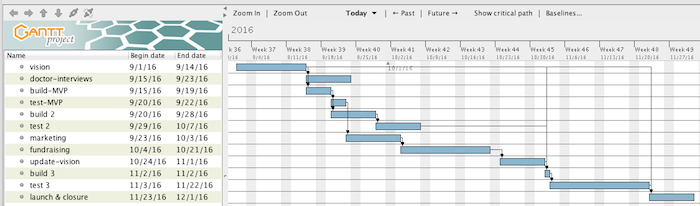
Tips and tricks for creating a software project schedule
Every project plan should contain an overall project schedule. Stakeholders want to know when results are delivered, and people involved want to know when their activities are planned. There are some standard techniques for creating schedules. In this article we give practical advice for making a workable plan for any software project.
Sieuwert van Otterloo
Software project effort estimation – the agile way
Estimating the effort needed to complete a certain software project is incredibly difficult. At the same time it is important to have some indication of development effort in order to estimate cost and decide whether to do the project. We shared four estimation methods with our students in our software project management course, and have…
Sieuwert van Otterloo
Four methods for software effort estimation
Understanding the size and effort of a software project early on is a difficult problem. Several different methods exist, but no method is perfect. In this article we present an overview of the four methods most mentioned in literature: 1) expert opinion-based, 2) top-down estimation, 3) bottom-up estimation and 4) estimation using a parametric or algorithmic model.
Joost Schalken-Pinkster
Getting non-functional requirements right
Getting non-functional requirements right early on is an important success factor for successful projects. This is why, in the course on software project management, one of the practical assignments focused exactly on this topic. In this article we summarize the most important steps: discovering requirements, making them precise and making them flexible .
Joost Schalken-Pinkster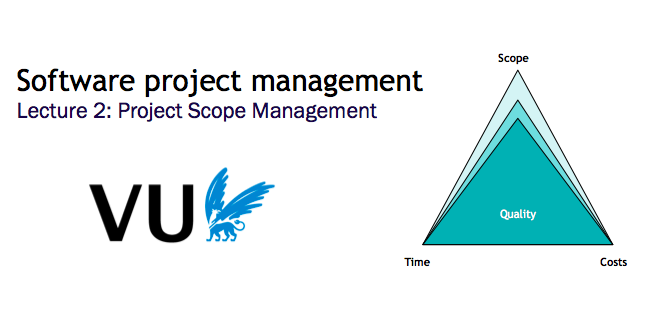
Software project management: managing scope
From March to May 2016, we are teaching the course Software Project Management at the Free University of Amsterdam. Each week we treat one aspect of project management, and last week we discussed project scope management. Managing project scope is crucial for project success, but unfortunately it is often neglected or undermanaged. In this article…
Sieuwert van Otterloo