

Better metrics for human-in-the-loop AI: our research at BNAIC 2026
| Deniz Sevim |
Artificial Intelligence
Research
Human supervision, measured properly
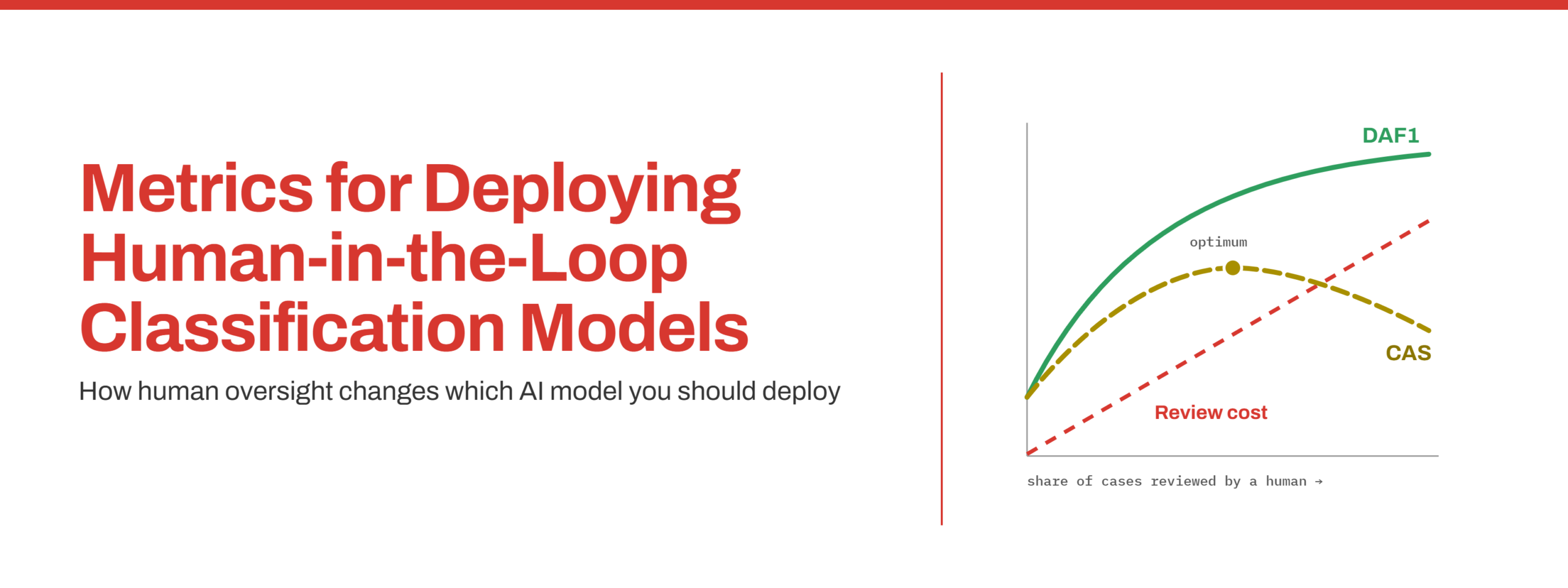
Many AI systems are not allowed to decide on their own. Uncertain predictions go to a human expert for review, yet we still choose models using metrics that assume the AI makes every decision itself.
Together with Code4Thought, we wrote a research paper on this gap: Metrics for Deploying Human-in-the-Loop Classification Models. We propose two new metrics that take human supervision into account. We show how our metrics, compared with traditional metrics, can change model rankings and error rates, and how they support discussions across engineering, operations and business stakeholders.
This research, together with other new publications from the field, will be presented at BNAIC/BeNeLearn 2026, the 38th Benelux Conference on Artificial Intelligence, on 22 October 2026 in Maastricht. For full details, see the Maastricht University website and the daily programme. Can’t wait until the presentation? Check out our informative poster.
Why human oversight changes the picture
AI models increasingly work alongside people. When a model is unsure, a human expert makes the final call. Legislation such as the GDPR and the EU AI Act requires this kind of human oversight for many high-impact uses, and many organisations add it anyway to avoid costly mistakes.
The way models are chosen has not caught up. Familiar scores such as accuracy or the F1 score assume the model makes every decision on its own. When people review part of the work, those scores describe a system that never actually goes live, and they can point decision-makers to the wrong model.
Our approach
In the paper we propose two metrics that take the human reviewer into account. The first shows how well a model performs on the decisions it is trusted to make by itself, while uncertain cases go to a person. The second adds the cost of that human effort, so organisations can see where extra review stops being worth it. We illustrate both with a cybersecurity example: a Security Operations Center where analysts review uncertain alerts.
Why it matters
Taking human review into account can change which model comes out on top. A simple, explainable model combined with a well-chosen share of human review can perform as well as a more complex and less transparent one. Just as importantly, the metrics give engineers, operations teams and management a shared language for discussing the trade-off between model quality, human effort and cost.
For organisations working towards AI Act compliance, this offers a practical way to make human oversight measurable rather than a box to tick.
Meet us at BNAIC/BeNeLearn 2026
We will present this paper during the poster session at BNAIC/BeNeLearn 2026 on 22 October 2026. BNAIC/BeNeLearn is the reference AI and machine learning conference for Belgium, the Netherlands and Luxembourg. This year’s edition runs from 21 to 23 October in Maastricht, hosted by Maastricht University and organised under the auspices of the Belgian-Dutch Association for Artificial Intelligence (BNVKI) and the Dutch Research School for Information and Knowledge Systems (SIKS). See the programme for the exact time, or read our poster in advance.
Authors: Pavlo Burda (ICT Institute), Petros Ioannis Stavroulakis (Code4Thought and Hellenic Military Academy) and Sieuwert van Otterloo (ICT Institute and Hogeschool Utrecht).
About Code4Thought: Code4Thought is a technology company with a unique purpose: to render technology transparent for large-scale software and AI-based systems.

Deniz Sevim is a specialist in ISO 27001, ISO 42001, and digitalisation practices. With knowledge and experience at the intersection of technology and society, auditing, and research, he connects the digital and human sides of organisations.