

Call for companies: research projects for VU Business Track 2027
| Deniz Sevim |
Project Management
Research

For the 2027 edition of the VU’s Computer Science Bachelor Research projects, ICT Institute is once again organising the Computer Science Business Track. We will supervise a new cohort of student teams working on real-world, data-driven challenges. We are looking for innovative organisations in the Netherlands, from scale-ups to public organisations, with substantial data, AI, security or software-innovation challenges that can provide a business problem and a company supervisor.
Participating organisations get state-of-the-art methods, fresh perspectives and prototype-level results, while helping to train the next generation of applied computer scientists.
Why the Business Track?
More and more organisations face practical data and software challenges that make excellent thesis problems. Students value working with real datasets, stakeholders and business constraints. Companies gain structured exploration, rapid prototyping and early access to talented graduates.
In the Business Track, students write a full individual thesis while working in a small team connected to a real organisation. Compared to the classic individual thesis, the track offers:
– Real business problems, with regular feedback from a company supervisor and a VU supervisor
– 6 to 9 teams of 2 to 3 students, each student solving their own sub-question
– Combined lectures, group feedback and individual coaching
– Structured intermediate deliverables and business-style presentations
– A realistic product-owner relationship between students and company
Previous editions
The 2027 track builds on three earlier editions (2024, 2025 and 2026). In 2026, more than 20 students completed their Business Track thesis, working with six organisations: Keysight, the Dutch Inspectorate for Education, Media Distillery, ClaroView, Caracal Intelligence and Dialogic. Topics ranged from validating LLM pipelines for TV broadcasts and summarising school inspection reports, to IT skill extraction from job vacancies, image recognition robustness, software maintainability and hardware fault injection. The VU Business Track Best Thesis Award 2026 went to Hani Al-Razzaz for his thesis “Summarising School Inspection Reports for Children and Parents With LLMs”, which combined prompt engineering, readability metrics and a user study with inspectors, parents and children. Read more about the results in our article on the 2026 edition.
How it works for students
Students form teams and each pick a unique, well-defined sub-question within the company’s written business problem. They collaborate as a team, but each student writes their own research plan, thesis and presentation, and is graded individually. On top of individual supervision by VU staff, students follow lectures and group sessions, and deliver several intermediate products and presentations, just as in a real company.
The main differences compared to the classic individual thesis track are:
-
Students work on an actual business challenge at a real company, present the achieved results and receive regular feedback from a company supervisor.
-
Each team consists of 2-3 students, with every student focusing on a distinct sub-question within the same overarching company problem or dataset.
-
On top of individual supervision from VU staff, students receive a mix of lectures and group sessions.
-
The track includes several structured intermediate deliverables and presentations – as in real companies – to help students plan and progress toward their final thesis.
The VU supervisors guard the academic side. Company supervisors meet the team regularly and provide domain context and expected outcomes.
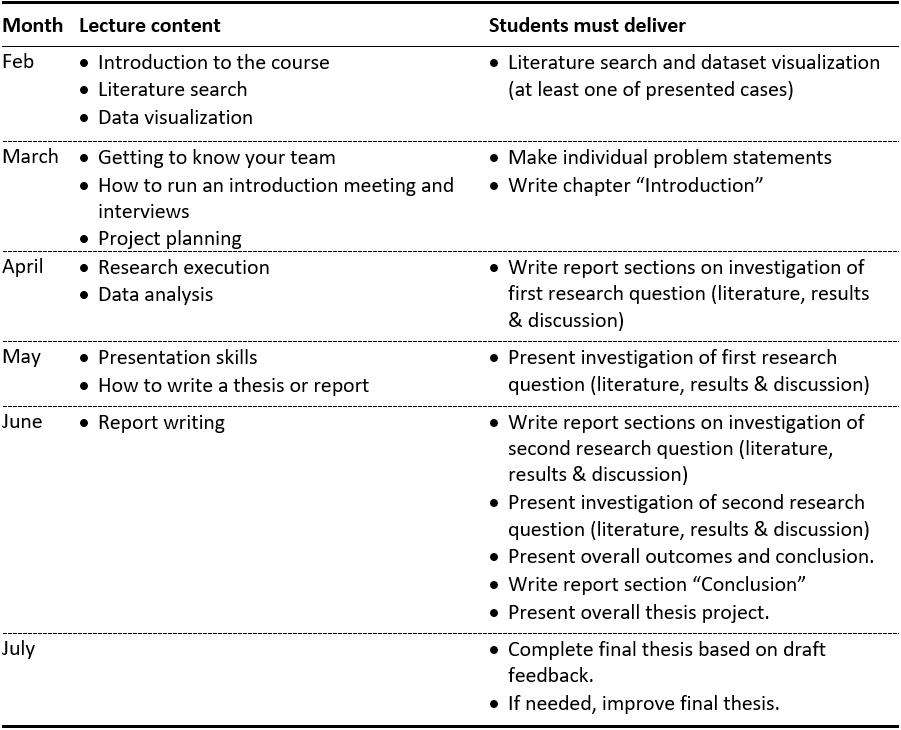
Timeline (February to July 2027)
Companies submit a problem statement (with our help, using a fixed template), give weekly feedback on progress, review draft thesis chapters, attend the interim and final presentations, and provide a short business-focused evaluation of the final report. Throughout the project, the company supervisor acts as product owner. We aim to select the partner companies before the Christmas holidays. Everything else, from the problem statements to the final presentations, takes place in the new year.
Benefits for organisations
Students work three days a week on your problem, for example trying different methods or automating steps of a process. Expect new ideas, data insights and software prototypes.
Because of the short research window and the international composition of the groups, this track is not an internship, and students receive no financial compensation. Students can visit the company periodically and meet weekly, online or on site. The company supervisor must be available weekly.
What you can expect
– A dedicated team of motivated Bachelor students, three days a week
– New ideas, data insights, prototypes or comparisons of modelling approaches
– Low overhead: no laptops, accounts or formal onboarding needed
– Joint supervision by VU staff to ensure structure and quality
– A chance to meet potential interns or future employees
Suitable topics
We are looking for challenges that can be split into 2 to 4 meaningful sub-questions, such as building a prototype for one task, analysing part of the data, or evaluating one modelling technique.
Data Science and AI: analytics on business datasets; forecasting, classification, NLP and search; retrieval-augmented generation prototypes; bias, fairness and model evaluation.
Innovative Software Engineering: algorithm design or optimisation; prototyping new features or interaction models; exploratory use of APIs, LLMs or low-code platforms. Regular software development with working software as the only goal is not suitable.
The problem statement
A 2 to 3 page document containing:
– A short description of the organisation and its challenges
– Background and role of the company supervisor
– The data or computer science problem, including what dataset, algorithm or prototype the company provides
– What the company provides (data, systems, domain expertise)
– Expected deliverables, such as a data visualisation, a machine learning model, an algorithm evaluation or a prototype
– Links to the company website and relevant documentation
The VU lecturers help scope and draft the problem description.
How to apply
In the coming months, the lecturers will reach out to selected companies, focussing on the public and private sector and open data, cyber security innovation, and data science and software engineering. Have a suitable challenge? Send a short email to Sieuwert van Otterloo with:
– A link to your company website
– A short description of your role
– A brief outline of your project idea
We look forward to another excellent edition of the VU Business Track!
Credit image: Jaykumar Bherwani via Unsplash

Deniz Sevim is a specialist in ISO 27001, ISO 42001, and digitalisation practices. With knowledge and experience at the intersection of technology and society, auditing, and research, he connects the digital and human sides of organisations.