

VU Computer Science Business Track results 2026
| Pavlo Burda |
Artificial Intelligence

Students of the Vrije Universiteit Amsterdam, bachelor Computer Science, have the option to graduate via the ‘Business Track’. A special graduation program with more team work, more support and real topics from real companies. In 2026 more than 20 students were selected for the business track and completed their this project. Once again we are happy to share a bit about the projects completed this year and announce the winner of the Best BSc Thesis Award.
Business track
The business track was conceived in 2023-2024 to provide students with more options for graduation options. Each year we do a call for companies to suggest research topics they are interested in (see the first business track call from 2023-2024, the second business track call from 2024-2025 and the call for this year’s business track from nov 2025). The business track is unique in the sense due to the fixed time line of the track, the option to work in groups while still delivering your own thesis, and the opportunity to work with companies. We are very grateful that six companies provide a case description, access to staff and / or data and provided feedback to the students.
We are also grateful to all students that worked hard and completed their thesis, providing new perspectives and approaches for important problems. While each student was successful in doing research and gaining knowledge, there are several students that really excelled and delivered outstanding work. In this article we therefore mention all the best theses, and also announce the annual VU Business Track Best Thesis Award.
TV broadcasts and LLMs
One group of students evaluated the correctness of LLM pipelines that generate video chapters and EPG schedules in TV broadcasts at Media Distillery. One students found out that, with limited data, the Gemini model appears to be effective at the task of suggesting precise EPG times based on transcripts and heterogeneous EPG data. Max build an automated validation combining combining heuristic rules (flagging 9% of chapters as having mistakes) and an LLM-as-a-Judge to classify chapters; this can reduce manual reviews by 70% at the price of 6% error rate. The following thesis are listed here as honourable mentions:
- (1) Jinrui Rao – Automated Reliability Assessment of AI-Based Program Boundary Predictions
- (2) Max Trapp – Automated Validation Frameworks to Increase the Accuracy of Large-Scale Video Analysis Pipelines
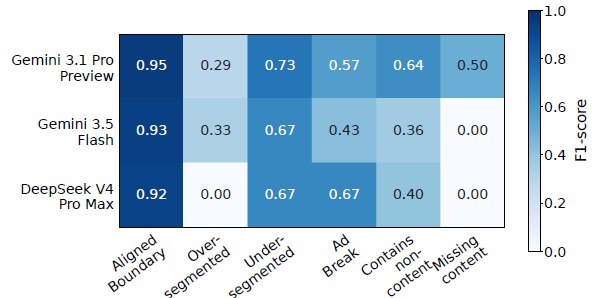
F1 score per LLM-as-a-Judge model and Chapter timing label (Trapp).
Education quality in the Netherlands
Another group of students took the challenge of analyzing the Dutch Inspectorate for Education (inspectie voor het onderwijs) reports on scholars’ performance in the Netherlands. Hani’s experiment evaluated various prompting and temperature setting of an LLM report summarizer and assessed its outputs in a user study with inspectors, parents and children. The surprising outcome is that children rated LLM summaries as comprehensible as much as the human-made ones, but with the need of human oversight: parents preferred the human written reports and inspectors flagged language errors. Romina developed a counterpart to Hani’s work by targeting a professional audience. She tested how chunking and prompting techniques influence report quality whereby she found out that sentence-based chunking is the closest to professional references, while still depending on the prompting strategy used. The following thesis are listed here as honourable mentions:
- (4) Hani Al-Razzaz – Summarising School Inspection Reports for Children and Parents With LLMs (0verall winner VU Business Track Best Thesis Award)
- (3) Romina Asgari – How Do Chunking and Prompting Strategies Affect the Quality of LLM-Generated Summaries of Inspection Reports for Professional Audiences?
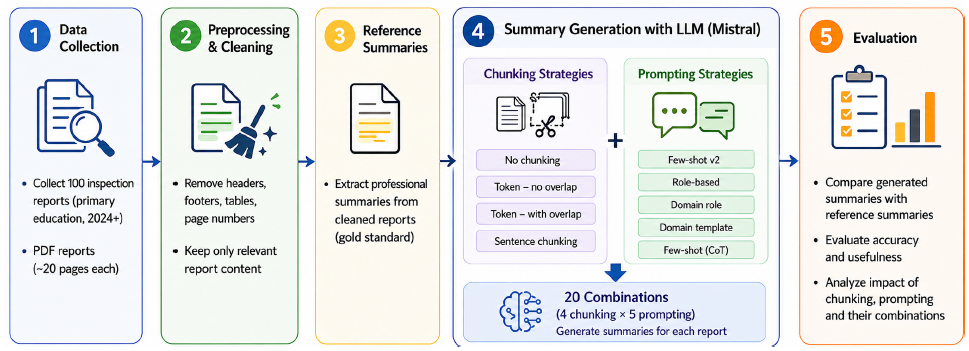
Overview of the research methodology for evaluating chunking and prompt engineering (Asgari).
Job market analysis
A third group analyzed large-scale job vacancy data at Dialogic and map the on the European e-Competence Framework. Nikitas compared two ways of extracting IT-relevant skills: a rule-based dictionary was fast to capture skills by explicit keywords, while a local LLM was able to extract skills implicit, paraphrased skills with high accuracy. Davide compared an NLP pipeline for searching more than 88k skills in few minutes vs. a more precise local LLM setup that takes several hours for extraction. Efforts by both students led to a pipeline combining a cheap deterministic ruleset for full-dataset trend tracking and the LLM for hard to detect skills on targeted samples. The following thesis are listed here as honourable mentions:
- (5) Nikitas Konstantopoulos – NLP-Based IT Skill Extraction and e-CF Mapping
- (6) Davide Lener – Job Vacancy Skill Extraction and Labor Market Analysis: Evaluating NLP and LLM Performance in the AI, Data, and Cloud Sectors
Image recognition and style transfer
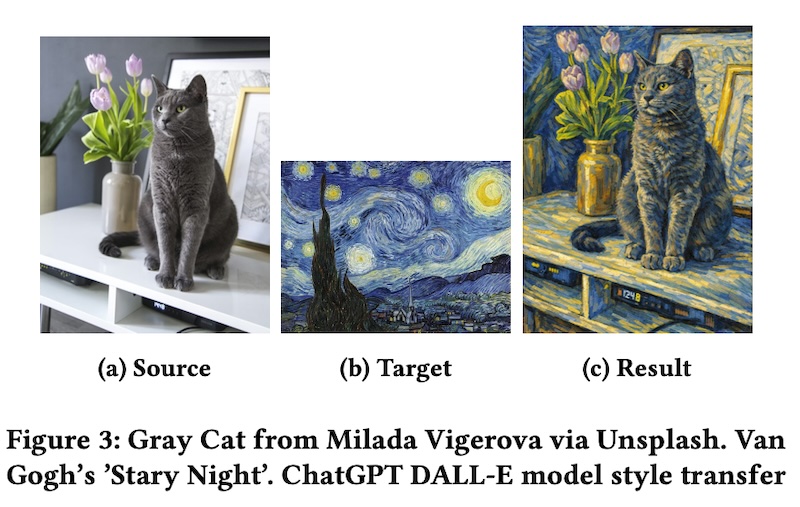
A fourth group of students tested the effects of image distortions and modifications with different image-matching algorithms. Rania tested new AI-based editing techniques like in- and out- painting that extend or modify an image with generative AI. She proved that image matching models are actually good in matching a similar image, but struggle to match modified images with heavy out-painting on half frame replacements. Laurens tested the effects AI-based style modifications, like applying a “van Gogh style” or a “Miyazaki style”. With a purpose-built dataset, he showed that some models are significantly better than others at detecting standard modifications, but most of the time they all fail under AI-style based modifications.
- (7) Laurens ten Voorde – Image Detection Systems vs. Stylization Changes
- (8) Rania Aouda – Quantifying Image Recognition Robustness Under AI Image Transformations
Software quality, AI-text detection and hardware fault injections
Further groups investigated various topics that were suggested by actual companies.
- Jasper van Heusden investigated software maintainability at ClaroView where he tested early-phase quality metrics vs. composite metrics in predicting future project mantainability using 40 Java and 40 Python open repositories. Surprisingly, the devised sliding-window forecasting model shows that the composite metric overperforms all sub-metrics.
- Kajetan Zajaczkowski studied machine learning models for trying to distinguish AI-generated text from human written text, and the ethical implications of “AI detectors” mistakes. While both logistic regression and random forests are able to detect most of the AI-generated text, still many errors remain. This can disproportionately hurt more vulnerable subject like non-native and neurodivergent writers.
- Jaydon Cheng jumped into the though world of hardware cyber security and signal processing: at Keysight, he investigated the effects of deliberate electro-magnetic impulses on a chip — and the resulting faults in instructions execution — to bypass security controls. He compared three representations of electric signals clustered along different outcome patterns.
- Ana Mafiyusef focused on the challenge of analysing software bug reports and problem tickets that organisations accumulate over time. These collections of bug reports and problem tickets can provide IT managers and IT auditors with insight into development projects and operational issues, provided they can still see the wood for the trees.
This resulted in the following honourable mentions:
- (9) Jasper van Heusden – Predicting Future Maintainability of Open-Source Software from Quality Metrics: A Comparative Study of Python and Java Projects
- (10) Kajetan Zajaczkowski – Detection Performance, Interpretability, and Ethical Trade-offs in Machine Learning Systems for AI-Generated Text
- (11) Jaydon Cheng – Auto-Encoder Based Clustering of Power Traces for Fault Injection Analysis
- (12) Ana Mafiyusef – Influence of Document Embedding and Clustering Techniques on the Quality and Interpretability of Topics Extracted from Issue-Tracking Datasets for IT Auditing
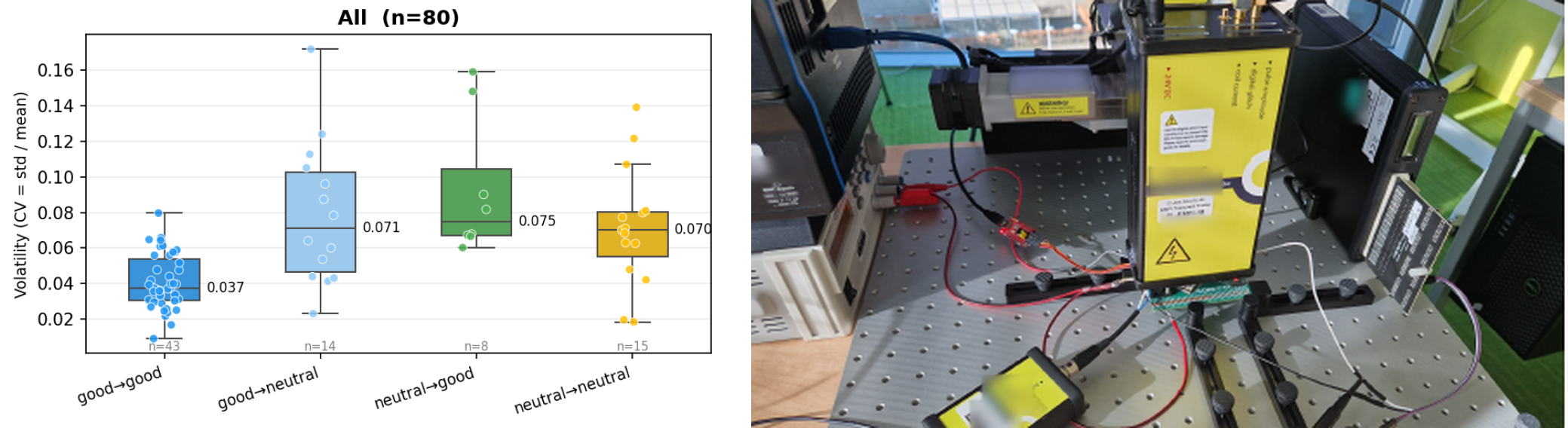
Distribution of within-project volatility in 80 projects (van Heusden). EM probe on testing harness for the injection campaign (Cheng)
Best Thesis Award
Although it was difficult to decide, we believe Hani’s thesis “Summarising School Inspection Reports for Children and Parents With LLMs” qualifies as the best thesis in the Business Track. His work was both relevant as it addressed how professional reports can be made more readable and accessible for children and parents, and included a good combination of multiple research techniques. He applied prompt engineering to optimize the results from LLM models, made good use of existing readability metrics but also included surveys where he presented different summaries to people to get their feedback. This combination of methods shows how computer science research has shifted away from formal proofs and algorithm design, and towards a human centered approach. Modern computer scientists must consider the effect of new IT systems and AI on people and be good at carefully evaluation new possibilities.
We believe this thesis is worth reading both because of the direct results on making reports more readable and as an example of how to address complex problems in a structured format. As a bonus, the thesis also includes multiple helpful visualisations such as the one below. It shows there is a trade-off between including information (measured via BERT-score) versus readability (measured using Flesh-Douma).
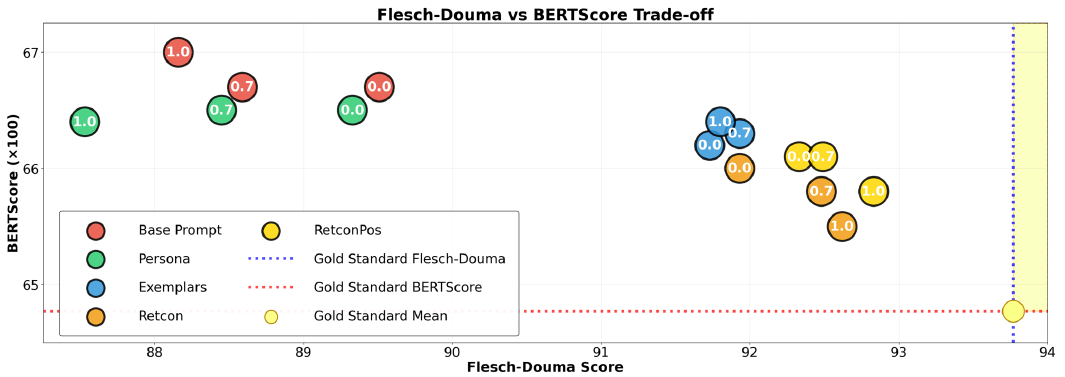
Trade-off between factual consistency and readability across prompting strategies and temperatures (Al-Razzaz).
The winning thesis can be downloaded here: Razzaz (2026) – Summarising School Inspection Reports for Children and Parents With LLMs – Full thesis PDF (LINK WILL BE ADDED AFTER APPROVAL)
Participating companies and further research
We are thankful to the company supervisors who co-led the projects and used their time to help the students in graduating. In no particular order, we would like to thank Keysight, the Dutch Inspectorate for Education, Media Distillery, ClaroView, Caracal Intelligence and Dialogic.
The business track is part of our overall effort to bring Computer Science research and applications together. Our other efforts include:
- a lot more bachelor and master thesis research (you can send an open application if you need a topic or research internship)
- A summer school ‘AI for non-AI students’ organised together with Utrecht University of Applied Sciences
- Various articles in the Computers and Society Research journal, such as about Fairness in hiring decisions or the Utrecht Housing dataset.
Featured image by Jerome Cha on Unsplash

Dr. Pavlo Burda is an IT consultant and researcher specializing in emerging cybersecurity threats and people analytics for security.