

Summerschool in Human Centered AI
| Sieuwert van Otterloo |
Artificial Intelligence
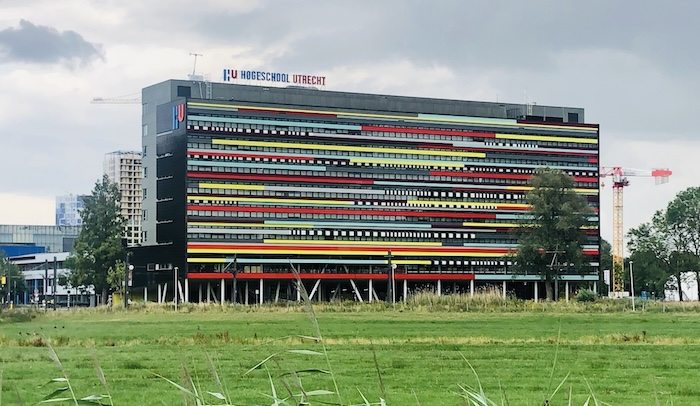
Every year Utrecht University and Utrecht University of Applied Sciences organize a series of summer course for international student that want to learn more about an advanced topic and also visit Utrecht. One of the most popular courses is the one week course “Introduction to AI and Machine Learning” led by Sietske Tacoma, Pavlo Burda and Sieuwert Van Otterloo. In this article you can find all information and links to further reading of the 2025 edition.
Why a summer school in AI and Machine learning
Artificial Intelligence is no longer just a part of computer science, but it has also become a social phenomenon: All students must understand AI and how it affects their field, and all AI researchers must understand the social implications of their research. To emphasise that AI must be used responsibly, many researchers now talk about Human Centered AI, responsible AI or Hybrid AI to emphasise that AI must be used to help and not hinder people. A summer school is a great way for students from all areas to learn about AI. At the same time it is a great way for the Utrecht AI research group to meet international visitors and discuss how AI impacts their life.
The summer school has become an annual tradition and it well attended by professional from all levels: bachelor students, master students, PhD students and working professionals, from Europe and further abroad. The international, diverse audience makes it a great week for learning about both the fundamentals and recent trends in AI. We as lecturers learned a lot from listening to the students who came up with creative designs and solutions to the various assignments.
Structure of the AI summer school
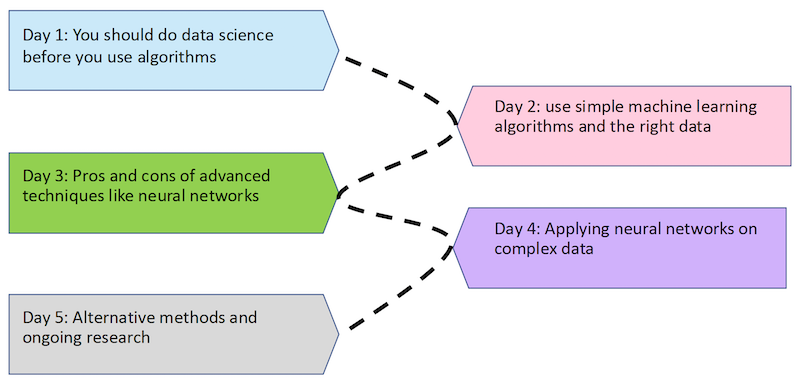
The summer school is a one week program with a different topic every morning. Monday morning is devoted to basic data science and data exploration. Tuesday is about traditional machine learning methods that are explainable and often effective. Wednesday is about decision making using neural networks, a typical more advanced method. Thursday is about using neural networks for image classification and other tasks. The friday is reserved for alternative methods including evolutionary algorithms. This structure has stayed the same as the first edition in 2021, since it also shows the historical development of machine learning and AI. Each year we have however made improvements based on advances in the field. There are more and better AI services and libraries and as a result, we could integrate better examples. In this edition we for instance used an upgraded housing dataset, discussed the latest AI models and looked at new, creative applications of AI.
The afternoon of every day is reserved for guest speakers who present more advanced topics, often related to ongoing research. It is a great way for researchers to see if their research results are explainable to a more general audience, and for students to learn about the research process.
Summer school material
For this summer school we try to use books, papers and datasets that are openly available. Each student received a paper booklet with selected papers for each day. If you are interested in the summer school, here is the list of material used and a link to the publicly available version:
- The Utrecht Housing dataset: A housing appraisal dataset by Sieuwert van Otterloo and Pavlo Burda, Computers and Society Research Journal (2025), 1 . This article describe the main dataset used. The dataset was chosen because it is small, real data, no personal data with clear target columns. The dataset is also on Kaggle where you can find example code.
- Long-Range Human Detection in Drone Camera Images Joris Heemskerk, Tina Mioch, Henry Maathuis, Huib Aldewereld. This arcticle was chosen since it shown a clear application of AI (computer vision) to support safety. It also shows some of the challenges in AI performance.
- The Illusion of Thinking: Understanding the Strengths and Limitations of Reasoning Models via the Lens of Problem Complexity
Parshin Shojaee, Iman Mirzadeh, Keivan Alizadeh, Maxwell Horton, Samy Bengio, Mehrdad Farajtabar
Apple learning research. This article was shown since it is a good example of how to evaluate AI models. - Creating Word Embeddings: Coding the Word2Vec Algorithm in Python using Deep Learning
Eligijus Bujokas – mar 2020 on medium. Code can be found on Github This accompanied the talk by Sietske Tacoma on how Large Language Models encode words in a way that preserves meaning similarity. - Guidelines for interface design for explainable AI – by Stefan Leijnen et.al. 2025 This is a whitepaper with requirements and examples how you can explain AI outcomes to users of AI systems.
- Chapter 1 from Neural Networks and Deep Learning, a free online book by Michael Nielsen, 2019. This chapter is a good explanation on how one can use neural networks to recognise digits from the MNIST dataset, a well known dataset for image recognition.
- Living guidelines on the RESPONSIBLE USE OF GENERATIVE AI IN RESEARCH, EU commission, second version April 2025. Many students use generative AI to do their homework, and many universities are trying to come up with sensible rules on when using AI is allowed and is not allowed. These are official guidelines. We encouraged students to find the rules from their universities and compare rules. As a bonus exercise we did a comparison with the controversial Radical New AI policy from ICT Institute.
- Eiben, A. E. (2002). Evolutionary computing: the most powerful problem solver in the universe? Dutch Mathematical Archive, 5/3(2), 126-131. Available via Nieuw Achief voor de wiskunde. A good historical overview of evolutionary algorithms.
- Ethics Guidelines for trustworthy AI, by the High Level Expert Group on AI. This article defines important values to consider when deploying AI, including human oversight, lack of discrimination, auditability and redress. It is a very good overview of the fundamentals for the ethical use of AI. If you find this interesting, please also consider this article on AI auditing.
Together these articles form a good starting point for learning machine learning and AI, both from the technical perspective and the human-centred perspective. We recommend all non-AI students to check these resources and get familiar with the basics of AI and machine learning.
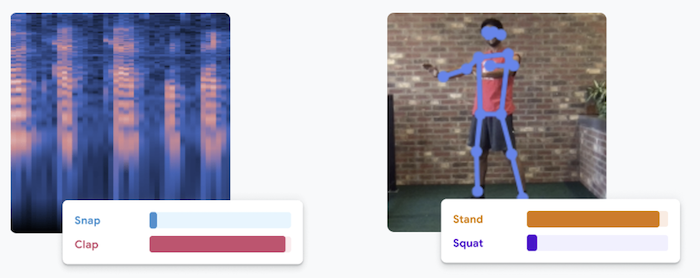
During the summerschool we also used the Teachable Machine by Google, a low code solution that allows you to teach the computer to recognise common objects (pens and cups) or gestures. You learn how AI is trained but also how fragile AI is when presented with new situations. Multiple students also used the Python Data Science handbook to become familiar with Python. We also experimented with materials from ongoing research, such as the Fair Insurance Pricing game.

Dr. Sieuwert van Otterloo is a court-certified IT expert with interests in agile, security, software research and IT-contracts. He is a also an ISO 27001 and NEN 7510 auditor and AI researcher.