

Utrecht Summerschool ‘AI for non-AI students’
| Sieuwert van Otterloo |
Artificial Intelligence
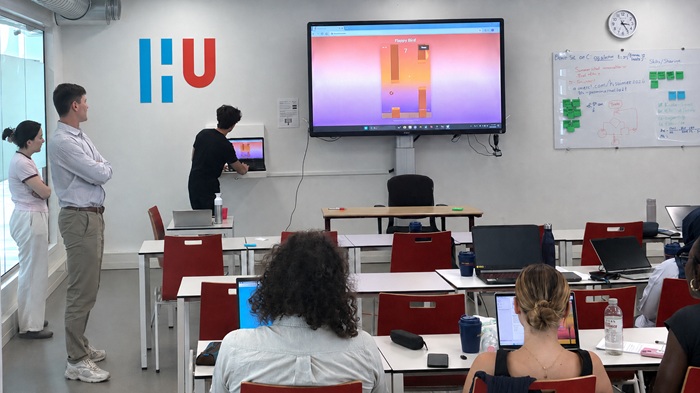
Every year the AI research group of the Utrecht University of Applied Sciences organises a summer school for international students that want to visit Utrecht and learn about a new research field. The course is open for students from all fields, and was attended this year by 15 students with backgrounds in law, economics, engineering, mathematics and business communication. In five days, these students learned what AI is and how it can be used, but also about risks and regulation. In case you missed it, this article contains links to the notebooks, papers, presentations and datasets used in the summer school.
How to start with AI
The morning program of this week long summer school was focused on learning what AI is and how AI models and algorithms are made. This was done using the Python programming language, open datasets from Kaggle and multiple common algorithms, like linear regression, decision trees and neural networks. On Monday, students focused on exploring and visualising data from the main example dataset: the Utrecht Housing Dataset. On Tuesday, several traditional, simpler machine learning techniques were used: linear regression, decision trees and random forests. These techniques are often used in practice because they are fast to use and give predictable and explainable results. Later in the week we focused on neural networks and evolutionary algorithms. Together this gives a good idea of machine learning and AI, and how any researcher can use AI on their own data.
Applications and Risks of AI
In the summer school we also explored the latest trends and applications. Our guest speaker and researcher Tina Mioch ,researcher focused on AI for emergency responders, showed how computer vision and AI can be applied to save people by helping first responders to automatically recognise humans from drone live footage. Tina van der Linden, researcher into ethical and legal aspects for AI such as use of GenAI in education, discussed with students how the law can help us address the risk of AI (and influence from Big Tech) in a grounded discussion at the intersection of technology and regulation. We further talked about principles of redress, biases, and group fairness in the context of fairness and how AI can condition our lives. To make it practical, all students played a serious game about price discrimination in car insurance that is available online and you can play yourself. .
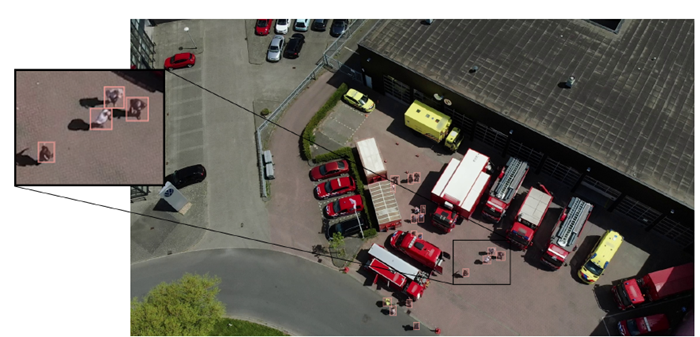
Long-Range Human Detection in Drone Camera Images – J. Heemskerk, T. Mioch, H. Maathuis and H. Aldewereld – ISCRAM 2024
New trends in AI
Sietske Tacoma explained and illustrated how textual information can be embedded into multidimensional vectors to be efficiently processed with Large Language Models (LLMs). Participants have experienced first hand how meaning in text is embedded and use in neural networks weights that make up the overall LLM architecture. Speaking of LLMs, Pavlo Burda took the participants through a practical tour of LLMs’ usage including latest trends and connected risks. Among case fabrications and advice to “eat rocks”, we tried to let models hallucinate and replicate findings on how human can(not) detect AI-generated images. A prompt engineering session culminated with participants applying the lates techniques on agentic coding by developing a browser-based arcade game.
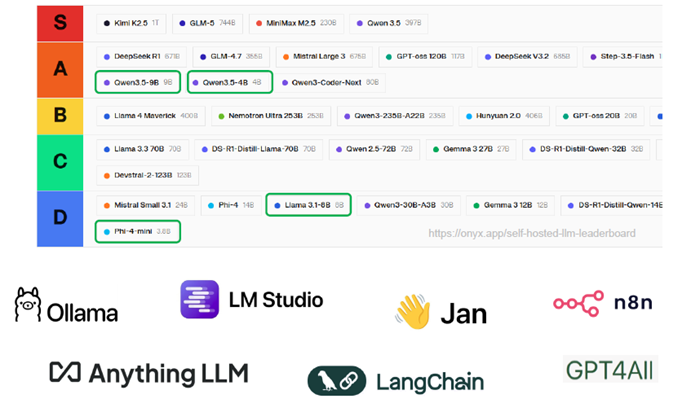
Popular open-weight local LLMs in 2026 according to onyx.app and a collection of tools for for local AI deployments and pipeline engineering.
From first-steps with Python for data science, to fine-tuning Artificial Neural Networks (ANNs) with the help of teachers and teaching assistants, every morning we provided focused practical exercises using Python notebooks that implement the theoretical explanations. During the hands-on practical sessions we experimented with prompt and context engineering by tackling simple Retrieval Augmented Generation (RAG) challenges, exploring the Hugging Face model repository to find local LLMs to deploy with AnythingLLM and experiencing agentic coding with tools like Cursor.
Recommended reading
For the whole duration of the summer school, and as a take away, we provided and discussed several articles and guides on AI. These resources have been compiled for every days of the 2026 program and as a further reading to deepen a given concept or exercise after a day session. All resources have been collected from open sources, maximizing the availability of the content for everyone.
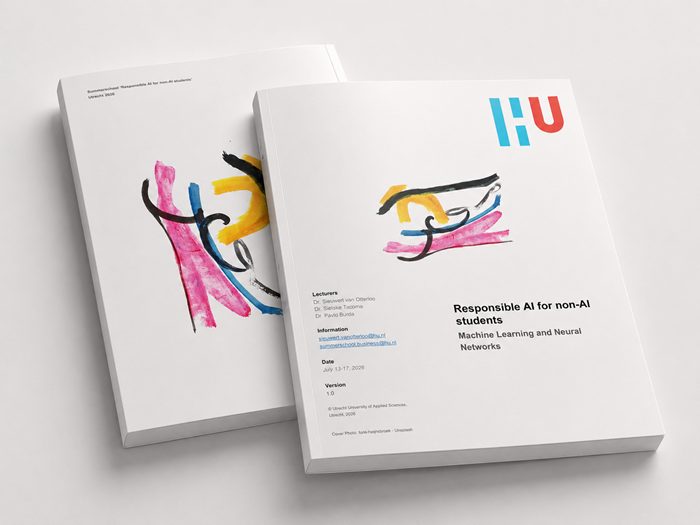
The participants received a booklet with the following chapters and articles:
- Python Data Science Handbook: this is recommended preliminary reading for anyone who has never programmed before.
https://jakevdp.github.io/PythonDataScienceHandbook - Utrecht Housing Dataset – 2025 – S. Otterloo and P. Burda. This paper introduces a small, real dataset to get familiar with data science principles. The dataset is available on data platform Kaggle: Utrecht Housing dataset.
https://ictinstitute.nl/utrecht-housing-dataset-2025/ - Long-Range Human Detection in Drone Camera Images – 2024 – J. Heemskerk et al.
https://ojs.iscram.org/index.php/Proceedings/article/view/75 - Handbook of Regression Modeling in People Analytics With Examples in R and Python (2nd Edition), chapter: Linear Regression for Continuous Outcomes – 2026 – Keith McNulty. This is a free book explaining how algorithms can make predictions.
https://peopleanalytics-regression-book.org - Creating Word Embeddings – 2020 – E. Bujokas. This online article explains how computers can handle natural language.
https://medium.com/data-science/creating-word-embeddings-coding-the-word2vec-algorithm-in-python-using-deep-learning-b337d0ba17a8 - Neural Networks and Deep Learning (free online book) Chapter 1 : Using neural nets to recognize handwritten digits – 2019 – M. A. Nielsen – http://neuralnetworksanddeeplearning.com/chap1.html
- Neural Networks and Deep Learning (free online book) Chapter 2: How the back propagation algorithm works – 2019 – M. A. Nielsen
http://neuralnetworksanddeeplearning.com/chap2.html - Generative Adversarial Nets – 2014 – Ian J. Goodfellow et.al.
https://arxiv.org/abs/1406.2661 - Ethics Guidelines for Trustworthy AI – 2019 – HLEG EU Commission
https://digital-strategy.ec.europa.eu/en/library/ethics-guidelines-trustworthy-ai - The most powerful computer in the world – NAW 5/3 nr. 2 juni 2002 A. E. Eiben
https://www.nieuwarchief.nl/serie5/pdf/naw5-2002-03-2-126.pdf - A Five-Phase Framework for Fair Insurance – 2025 – Mercuur, van Otterloo, Aldewereld, Proceedings of Fourth European Workshop on Algorithmic Fairness, PMLR 294:251-264, 2025.
https://proceedings.mlr.press/v294/mercuur25a.html - New developments in AI. This year we added two guest talks focusing on new trends like agentic coding, prompt and context engineering, and experimenting with Local LLMs.
https://ictinstitute.nl/wp-content/uploads/2026/07/Easy-RAG-and-exploring-local-llms_Burda.pdf
https://ictinstitute.nl/wp-content/uploads/2026/07/Risks_and_prompts_generative_ai_Burda.pdf
Image: taken by Sieuwert van Otterloo. The HU logo was inserted using AI.

Dr. Sieuwert van Otterloo is a court-certified IT expert with interests in agile, security, software research and IT-contracts. He is a also an ISO 27001 and NEN 7510 auditor and AI researcher.