

Call for companies: research projects for VU Business track 2026
| Pavlo Burda |
Project Management
Research
Research

For the upcoming 2026 edition of the VU’s Computer Science Bachelor Research projects, ICT Institute is again organising the Computer Science Business Track where we supervise a new cohort of student teams working on real-world, data-driven challenges. We are looking for innovative companies in the Netherlands (from scale-ups to public organisations) with substantial data, AI, security or software-innovation challenges that can provide a business problem and a company supervisor.
Participating organisations will benefit from state-of-the-art methods, fresh perspectives, and prototype-level results, while helping train the next generation of applied computer scientists.
Why the Business Track?
As computer science increasingly becomes embedded in everyday business operations, many organisations now face practical data and software challenges that are excellent thesis problems. Students value the opportunity to work with real datasets, stakeholders, and business constraints, and companies gain from structured exploration, rapid prototyping, and early access to talented graduates.
The Business Track enables students to deliver a full individual thesis while also working as part of a small team connected to a real organisation. Compared to the classic individual academic thesis, the Business Track includes:
-
Real-world business problems with regular feedback from a company supervisor and the VU supervisor
-
6-9 teams of 2-3 students, each solving their own sub-question
-
Combined lectures, group feedback, and individual coaching
-
Structured intermediate deliverables and business-style presentations
-
A realistic “product-owner” interaction pattern between students and companies
Previous years’ editions
The Business Track builds on the experience from previous years’ editions (2024 and 2025). In 2025, twenty Computer Science students successfully completed their Business Track theses with support from ICT Institute, working on a wide range of real-world challenges. The student teams collaborated with ten innovative organisations spanning applications in e-health AI, machine-learning-based diagnostics, cybersecurity analytics, recommender systems, anomaly detection, RAG-based prototypes, low-code data engineering, and environmental forecasting.
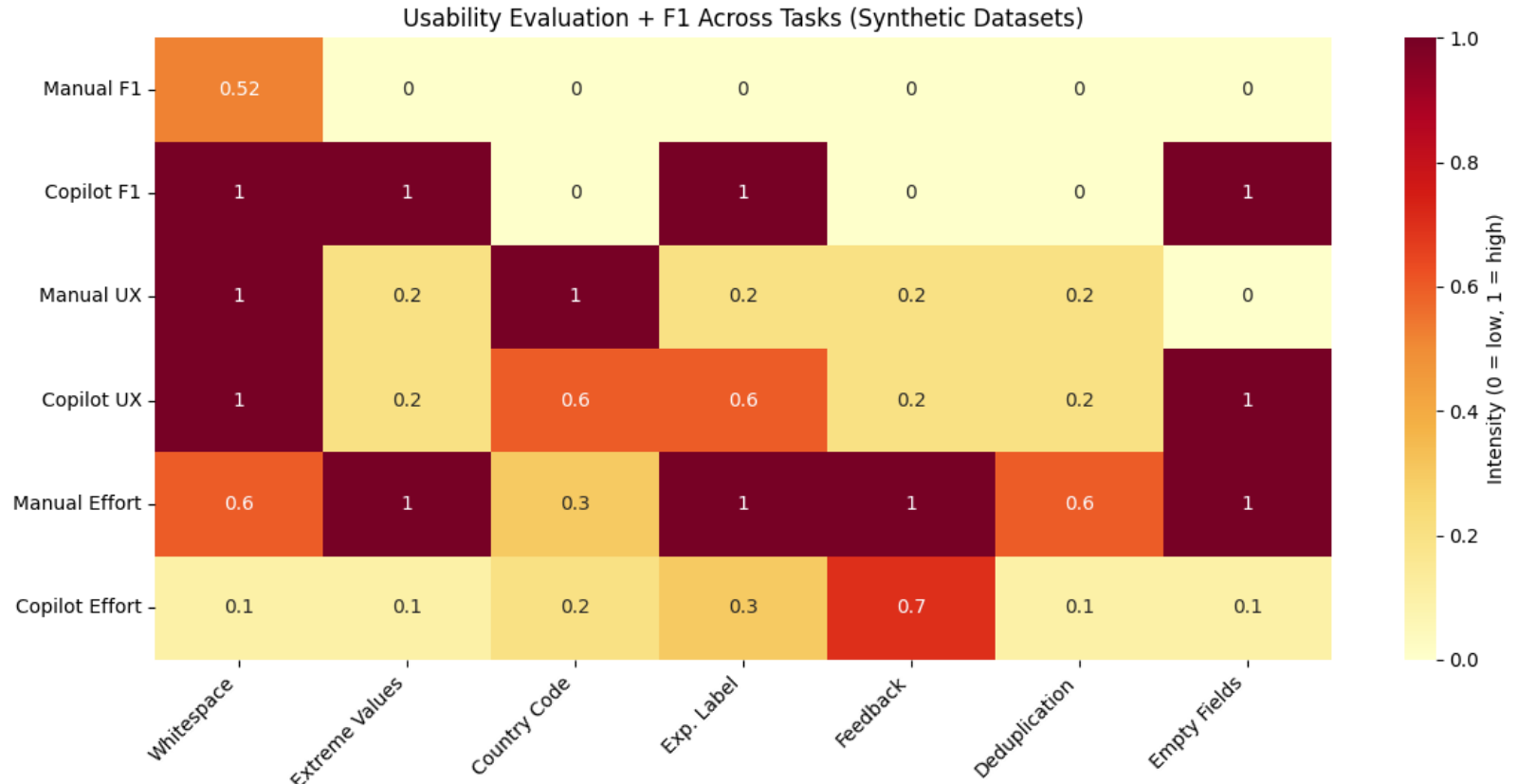
Read more about the 2025 edition concluded with impactful academic and practical results, such as LLM applications to threat intelligence, sensor-based health diagnostics and air pollution forecasting. The Business Track Excellent Thesis Award 2025 (top 5%) was awarded to Oliwer Dembicki for his thesis “Enhancing Data Reliability for Power BI: A Practical Evaluation of Microsoft Fabric’s Preprocessing Capabilities” evaluating Microsoft Fabric capabilities in improving or replacing the company’s current manual preprocessing workflows (see below).
Approach for this year – student perspective
Students make teams and select a unique, well-defined sub-question within the company’s written business problem. While they collaborate as a team of 2-3 people, each student produces their own research plan, thesis, and presentation, graded individually.
The main differences compared to the classic individual thesis track are:
-
Students work on an actual business challenge at a real company, present the achieved results and receive regular feedback from a company supervisor.
-
Each team consists of 2-3 students, with every student focusing on a distinct sub-question within the same overarching company problem or dataset.
-
On top of individual supervision from VU staff, students receive a mix of lectures and group sessions.
-
The track includes several structured intermediate deliverables and presentations – as in real companies – to help students plan and progress toward their final thesis.
The VU supervisors (Joost, Sieuwert, Pavlo) support the academic trajectory; company supervisors periodically meet with the team and guide domain context and expected project outcomes. The collaboration model mirrors industry practice, with clear deliverables and rapid iteration.
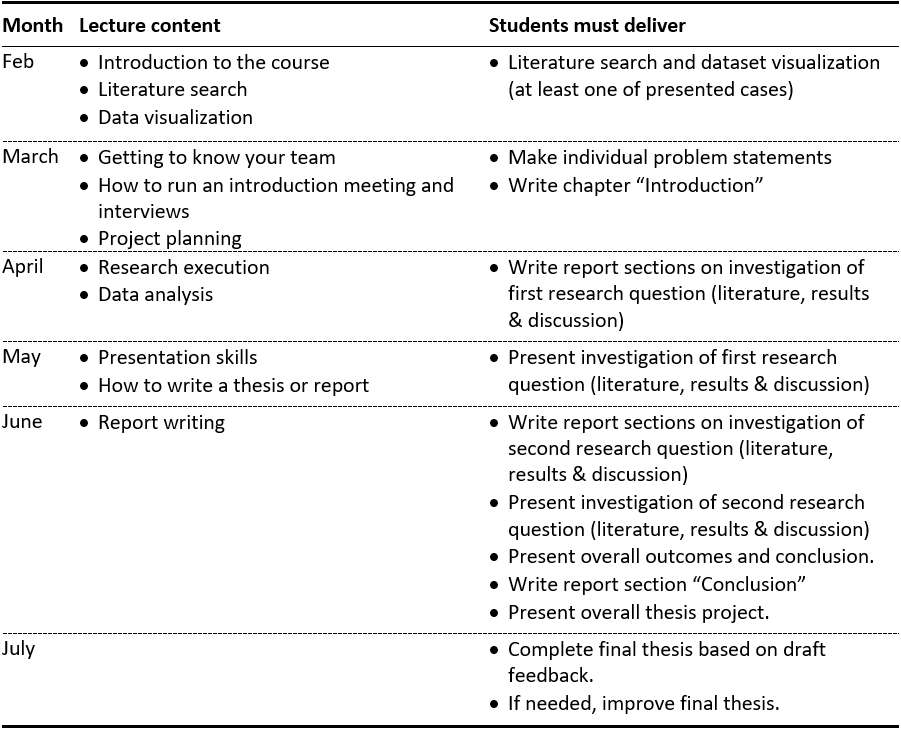
Timeline (February-July 2026)
To support predictability and smooth collaboration, the Business Track follows a clear schedule, as seen below. Companies submit their problem statement (helped by us and using a fixed template), have a weekly feedback on progress reports, review draft thesis chapters, attend interim and final presentations and review final report and provide a short business-focused evaluation. Throughout the project, company supervisors act as “product owners,” clarifying expectations and providing connections to relevant domain experts and stakeholders.
Benefits for Organisations
The students will work on the problem specified by the business, for instance trying different methods or automating different steps of a process. Students are expected to work three days a week on the Bachelor Project, so you can expect quite some new ideas, data insights or software prototypes to help you explore and solve your problem.
Because of the short research window and international composition of the groups, this track is not an internship. It has also been decided not to provide financial compensation to students, since this is difficult to arrange for all of them. Students could visit the company periodically, and meet weekly online or onsite, focusing on research outcomes relevant to the problem statement. The company supervisor must be available weekly.
Participating companies can expect:
-
A dedicated team of motivated Bachelor students working three days per week on your challenge
-
New ideas, data insights, prototypes, or comparisons of modelling approaches
-
Low overhead – companies do not need to provide laptops, accounts, or formal onboarding
-
Joint supervision and support from VU supervisors to ensure structure and quality
-
A chance to meet potential interns or future employees
Suitable project topics
We invite topics and challenges that can be split into 2-4 meaningful sub-questions. The sub-questions can be related, e.g. create prototype for one task, analyse part of the data, or evaluate one modelling technique. Examples include:
Data Science & AI projects – projects that rely on using business datasets to help solve business problems using analytics and machine learning/AI:
-
Analytics on business datasets
-
Forecasting, classification, NLP, search improvement
-
Retrieval-augmented generation prototypes
-
Bias, fairness, or model evaluation studies
Innovative Software Engineering projects – projects that relate to using innovative solutions to new problems that result in a prototype that demonstrates the new algorithm/solution, it should therefore not be regular software development projects that only have working software as their final goal:
-
Algorithm design or optimisation
-
Prototyping new features or interaction models
-
Exploratory use of APIs, LLMs, or no-code/low-code platforms
The problem statement
The description of the business problem should be a 2-3 page document that contains:
-
Short description of the organisation and their challenges
-
Short background and role of the company supervisor
-
A business related Data or Computer Science problem. The problem description should make clear what dataset the company will provide (including, e.g., current algorithm, design or prototype)
-
What the company will provide (data, systems, domain expertise)
-
Expected deliverables (e.g., visualization of data, a machine learning model, algorithm evaluation or a prototype)
-
Links to company website, existing relevant resources or documentation (e.g., whitepapers or published resources that the company supervisor expects students to read)
The VU lecturers will assist in scoping and drafting of the business problem description.
How to apply
Over the coming months, the lecturers team (Joost, Pavlo and Sieuwert) will reach out to selected companies based on matching expertise. The focus of Joost is on public sector and open data. The focus of Pavlo is on innovation around cyber security and the focus of Sieuwert is advances in data science and software engineering. If your organisation has a suitable challenge and would like to host a student team, please send a short email to Sieuwert van Otterloo including:
-
A link to your company website
-
A short description of your role
-
A brief outline of your proposed project idea
We look forward to another excellent edition of the VU Business Track and to collaborating with organisations committed to innovation, data excellence, and practical impact.
Cover image: by Lindsay Henwood on Unsplash

Dr. Pavlo Burda is an IT consultant and researcher specializing in emerging cybersecurity threats and people analytics for security.